
Five Things That Mattered This Week | May 8, 2026
Mosquito fleets, Project Freedom lasted 24 hours, "it's just a love tap", a son of Hamas killed, Beijing encroaches upon Manila. There's been tit for tat and missiles. Get your coffee, we've got news!

Good Friday morning! The news gave birth to more news and then u-turned and then exploded midweek. Here we all are. We made it. Take a seat.
Renewed fighting broke out around the Strait of Hormuz after Iran accused the U.S. of violating the ceasefire. U.S. Navy destroyers were surrounded by another Iranian “mosquito fleet”. Asymmetric warfare and swarm tactics at sea are the Artesh’s most effective methods. The CIA says the U.S. only has three to four months before severe hardship. Rubio declared Operation Epic Fury is officially over as Project Freedom commenced only to be a bust within 24 hours. Is Cuba next on the list? Russia told foreigners to leave Moscow ahead of the 81st anniversary of the Soviet victory over Nazi Germany. A ceasefire was declared to last from May 8 to May 10. Kyiv says Russia has continued drone strikes. Ukraine kept up its long-range pressure campaign, targeting Russian infrastructure. The son of a senior Hamas official was killed by Israeli forces. Tokyo and Manila have also agreed to begin talks on a weapons-transfer pact as China continues aggressive territorial encroachment. Trump’s planned withdrawal of 5,000 U.S. troops from Germany is deepening NATO friction. Pyongyang is widening the threat picture on the Korean Peninsula. Sudan’s army alleged UAE and Ethiopian links to a drone attack on Khartoum airport. The UAE vociferously denies the claim.
And because we’re in the weirdo timeline, we now have suspiciously timed oil trades that have joined the U.S.–Iran war story. Reports say well-timed bets on falling oil and fuel prices may have totaled as much as $7 billion ahead of major Iran-related announcements. The DOJ and CFTC are probing at least $2.6 billion in trades placed before market-moving statements by President Trump and Iranian officials.
We’ve got graphs, maps, thoughts and art, of course! Come, bring your coffee and reading glasses, stretch out a bit and let’s go over the headlines together.
Did you find the Kintsugi, Fairuz and Leonard Cohen easter eggs?!
Thank you for reading this far. Paid subscribers get full access to Grounded Perspectives and our Friday wrap ups, plus much more. If you’re so inclined, throw a couple coins into our human battery fund — also known as mochas and green teas. We’re glad you’re here.
The week gave us twists, pauses, and paper promises. The story bent. Now we wait to see what breaks… and what heals. — Ali & Asli
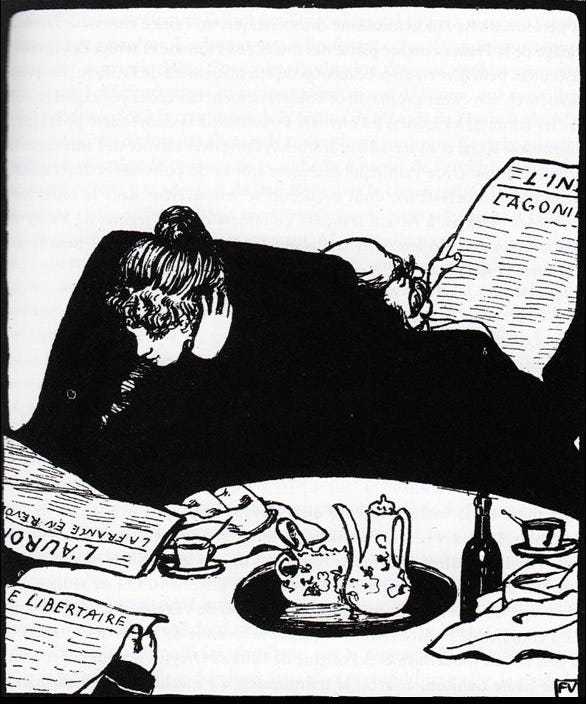
A glimpse into a family table of dissenting political thought
"En famille" by Félix Vallotton | woodcut published in Le Cri de Paris, February 13, 1899 | The father of the family reads the anti-Dreyfusard newspaper L'Intransigeant while the young woman, with her back to him, is immersed in the Dreyfusard daily newspaper L'Aurore. In the lower left corner, his son reads Le Libertaire, an anarchist sheet then directed by Sébastien Faure, favorable to Dreyfus.
Upgrade to paid for just $5 and you’ll get full access to all our Friday wrap ups! It’s worth it. We always bring the juice!

The Big Stories
🎯 Ceasefire on Paper, Firepower at Sea | The U.S.–Iran ceasefire is holding in name more than in spirit. Renewed fighting broke out around the Strait of Hormuz after Iran accused the U.S. of violating the ceasefire, while Washington said American forces acted in self-defense after U.S. Navy destroyers came under Iranian missile, drone, and small-boat fire. U.S. Central Command said it responded by targeting Iranian military sites, including drone and missile launch facilities. Iran, meanwhile, accused the U.S. of striking vessels near Jask and Fujairah and hitting civilian coastal areas near Bandar Khamir, Sirik, and Qeshm Island.
Oil jumped again on the escalation, with Brent around $101.47 and WTI near $95.93, as markets tried to price the difference between a possible peace memo and the still-unresolved reality of Hormuz. The draft framework reportedly aims to halt the war, address the strait, and open a 30-day negotiating window for a broader agreement, but the hardest issues remain untouched like Iran’s nuclear program, enforcement mechanisms, shipping security, sanctions relief, and whether China or Russia would support, obstruct, or try to reshape any guarantor role.
This ceasefire is less a settlement than just another stress test that we've become so accustomed to in this ambiguous tit-for-tat war. Every exchange of fire raises the risk that Hormuz becomes both battlefield and bargaining chip. This where military escalation, oil prices, maritime law, and great-power diplomacy all collide.
China and Russia have already shown resistance to U.N. moves over Hormuz, including a previous draft resolution calling for an end to Iranian attacks and protection of commercial shipping, which they vetoed in April.
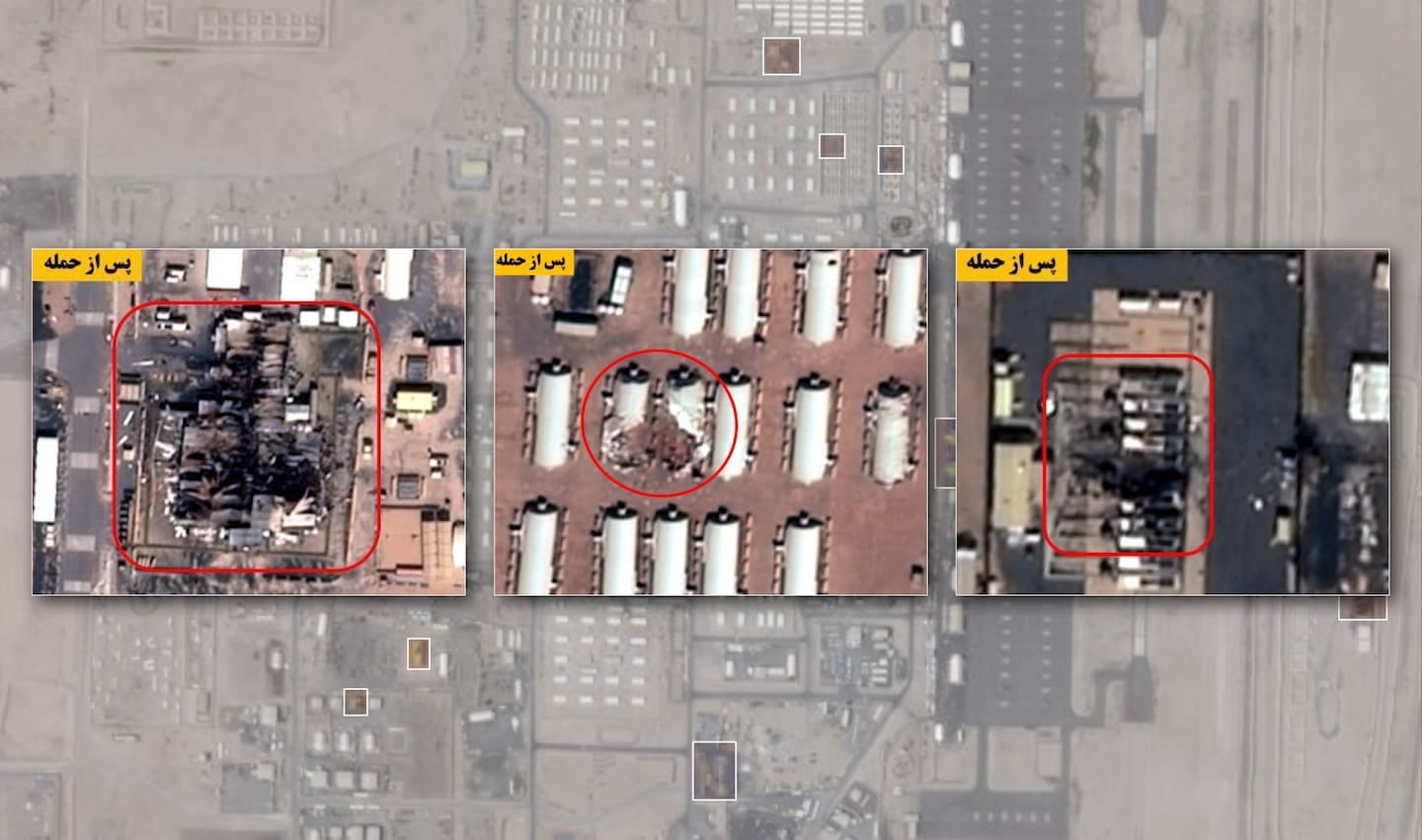
Rendering of Camp Buehring in Kuwait, released and annotated by Iranian state-affiliated media. Camp Buehring (formerly Camp Udairi) is a major U.S. Army installation in northwestern Kuwait, located about 25 miles south of Al Jahra near the Iraqi border. It serves as a primary staging post, training hub, and theater reserve for U.S. forces in the Middle East, with capacity for roughly 14,000 personnel.
(Washington Post illustration; Center row: Iranian state-affiliated media)
Iran has not only squeezed Hormuz. It has tested the architecture behind the U.S.’s entire regional posture. Satellite imagery reportedly shows Iranian strikes damaged or destroyed at least 228 U.S. buildings and pieces of equipment across Middle East military sites. This level of destruction is far beyond what Washington has publicly emphasized. So the ceasefire is doing double duty: trying to quiet the Strait while exposing a harder question that lies deep in the sea beneath it. Does U.S. deterrence still look sturdy when bases, ships, partners, and supply lines are all within reach?
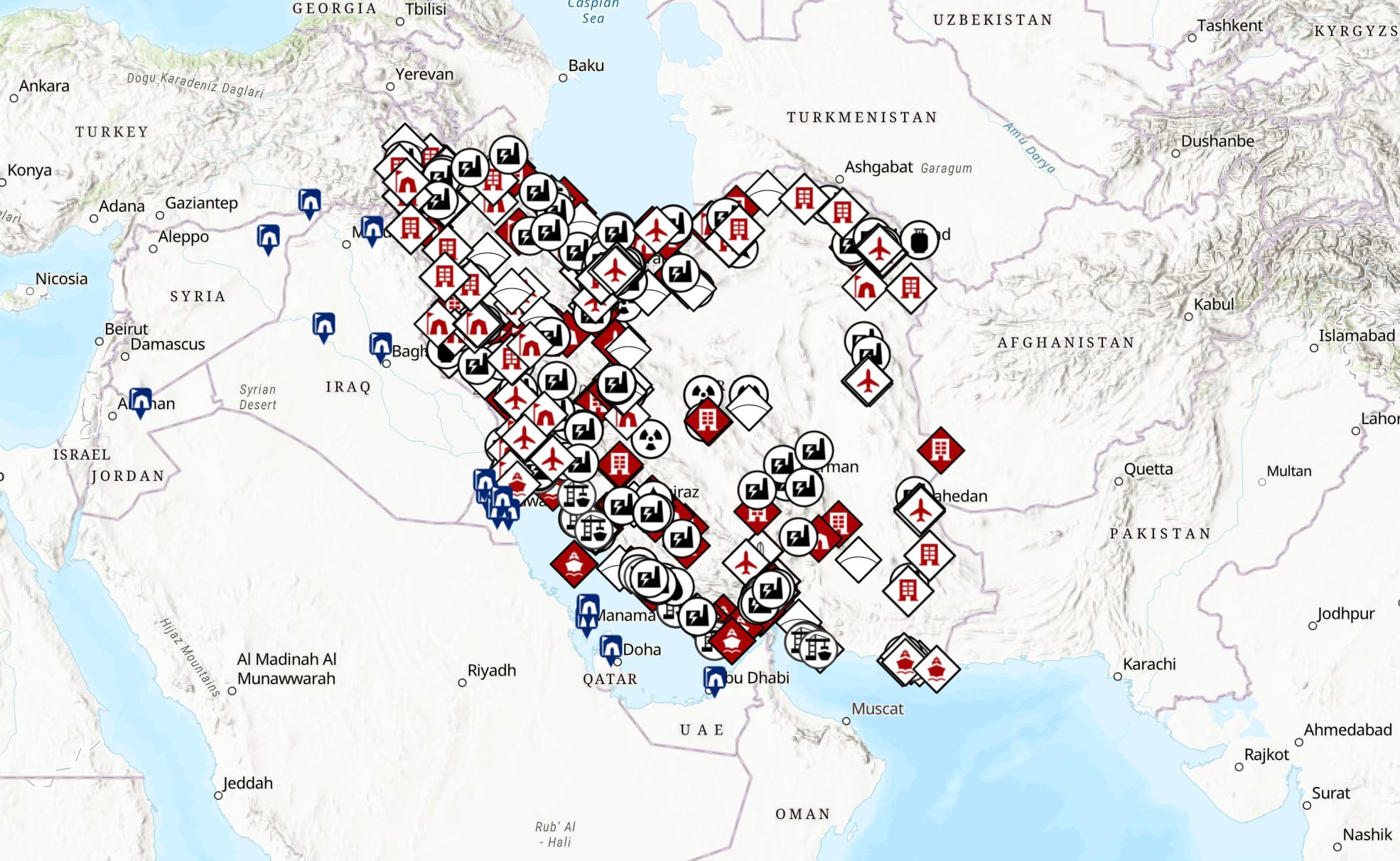
U.S. & Israeli joint force strikes on Iranian targets via Story Maps
Missiles were reported across the UAE early Friday after Iran attacked three U.S. destroyers transiting Hormuz. Trump said no damage was caused and claimed the ceasefire still holds, while Washington described its own strikes as self-defense. But the arrangement is becoming harder to sustain. We have a ceasefire that leaves Hormuz closed, U.S. ships under threat, Gulf allies exposed, and oil markets on edge is not really a ceasefire. It is a pressure campaign by another name. Iran likely believes it can extract more concessions by keeping the war going, especially ahead of Trump’s meeting with Xi Jinping. Tehran may have only one card left, but it is the one that moves the whole table.
“It’s just a love tap.” — President Trump
Secretary of State Marco Rubio has declared Operation Epic Fury over, marking the formal end of the U.S. offensive campaign against Iran and the shift into Project Freedom, a narrower maritime-security mission focused on reopening commercial passage through the Strait of Hormuz. Project Freedom only lasted a day. Where do we go from here, no one knows. The announcement gives Washington a new frame for the crisis: no longer open war, but enforcement, escort, and deterrence at sea. It also helps the administration move past the War Powers pressure that came with the earlier military campaign, even as the underlying dangers remain unresolved. Hormuz is still unstable, Iran’s nuclear file is still open, shipping remains exposed, and the ceasefire remains fragile. The operation may have ended on paper, but the crisis has simply moved into its next phase.
A new CIA assessment reportedly undercuts Washington’s hope that pressure on Iran will produce fast collapse or fast concessions. According to the Washington Post, U.S. intelligence believes Iran could withstand the U.S. naval blockade for at least 90 to 120 days — roughly three to four months — before severe economic hardship fully sets in. That is a politically awkward timeline for Trump’s Washington: long enough for Iran to keep firing, smuggling, rationing, and waiting out pressure, while oil markets, Gulf partners, and U.S. military assets absorb the strain. The blockade may be costly, reportedly draining Iran by hundreds of millions of dollars per day, but the CIA assessment suggests Tehran still has enough resilience — including missile capacity, drone stockpiles, and oil workarounds — to turn time itself into leverage.
Inside Iran among the people, the ceasefire has not brought anything close to relief. Ordinary Iranians are living between external war pressure and internal state repression: strikes, shortages, fear, blackouts, economic strain, and the tightening hand of a regime that often treats public anxiety as a security threat. Rights groups say Iran has sharply escalated executions in recent weeks, with families pressured into silence and many detainees facing death sentences tied to anti-government protests or espionage allegations. The war has also created cover for the state to intensify repression while the outside world watches oil prices and naval movements.
For Iranians, Hormuz is not just a chokepoint on a map. It is another name for a life squeezed between bombardment, inflation, censorship, and the machinery of fear.
Activist Yalda Roshan shares updates on the
blackouts, abusive treatment of protestors and executions in Iran
