Five Things That Mattered This Week | June 19, 2026
A Trump Iran deal that's like the JCPOA?, Ukraine struck the heart of Moscow, Cuba invites investment and is met with lawsuits, G7 closes ranks vs China. AI comes for us all. We've got art!

Welcome to our Friday headlines!
What a week … we’re over here building fences and packing up homes for a big move. And of course, surrounded by news of all sorts. Let’s get into it!
This week, the map changed less by conquest than by pressure. Fuel routes reopened, refineries burned, property rules bent, old claims resurfaced, and minerals became the new strategic bloodstream. War did not end. It moved into contracts, ports, courts, tankers and balance sheets. We brace for impact.
Ukraine carried out its largest air raid on Moscow since the start of Russia’s full-scale invasion, striking the Kapotnya oil refinery and disrupting major airports. NATO’s Prioritized Ukraine Requirements List program is offering up another $1 billion to Ukraine in the war effort.The Iran deal is less a grand bargain than a 60-day escrow arrangement: Iran gets space, oil gets movement. The peace dividend is real, but provisional. Oil moved first, trust has not. This “deal” also includes a $300 billion private investment fund for Iran.
What is being redrawn this week is not only territory, but ownership: of ports, fuel, leverage, memory, minerals, and the stories nations tell about why they must move the way they do.
The week ahead provides so many horizons to watch. Lebanon, Israel and an emboldened Hezbollah. Hormuz traffic. The $300 billion reconstruction and development fund. Iran’s nuclear language. Watch for Trump’s own coalition.We brought the juice. We’ve got headlines, graphs, predictions, analysis, and art!
Thank you for reading this far. Paid subscribers get full access to Grounded Perspectives and our Friday wrap ups, plus much more. If you’re so inclined, throw a couple coins into our human battery fund — also known as mochas and green teas. We’re glad you’re here.
Until Monday. May your weekend bring you a brand new perspective.— Ali & Asli

🎯 The Iran deal is being sold as peace, but it reads more like a ceasefire written by the oil market. Trump entered the war promising decisive force. He exits this phase with Iran still standing and a framework that gives Tehran legitimacy, revenue pathways, and time. That does not mean Iran won everything. Its economy is battered, its infrastructure damaged, and sanctions relief remains conditional. But it does mean the U.S. did not get the clean surrender its hawks wanted.


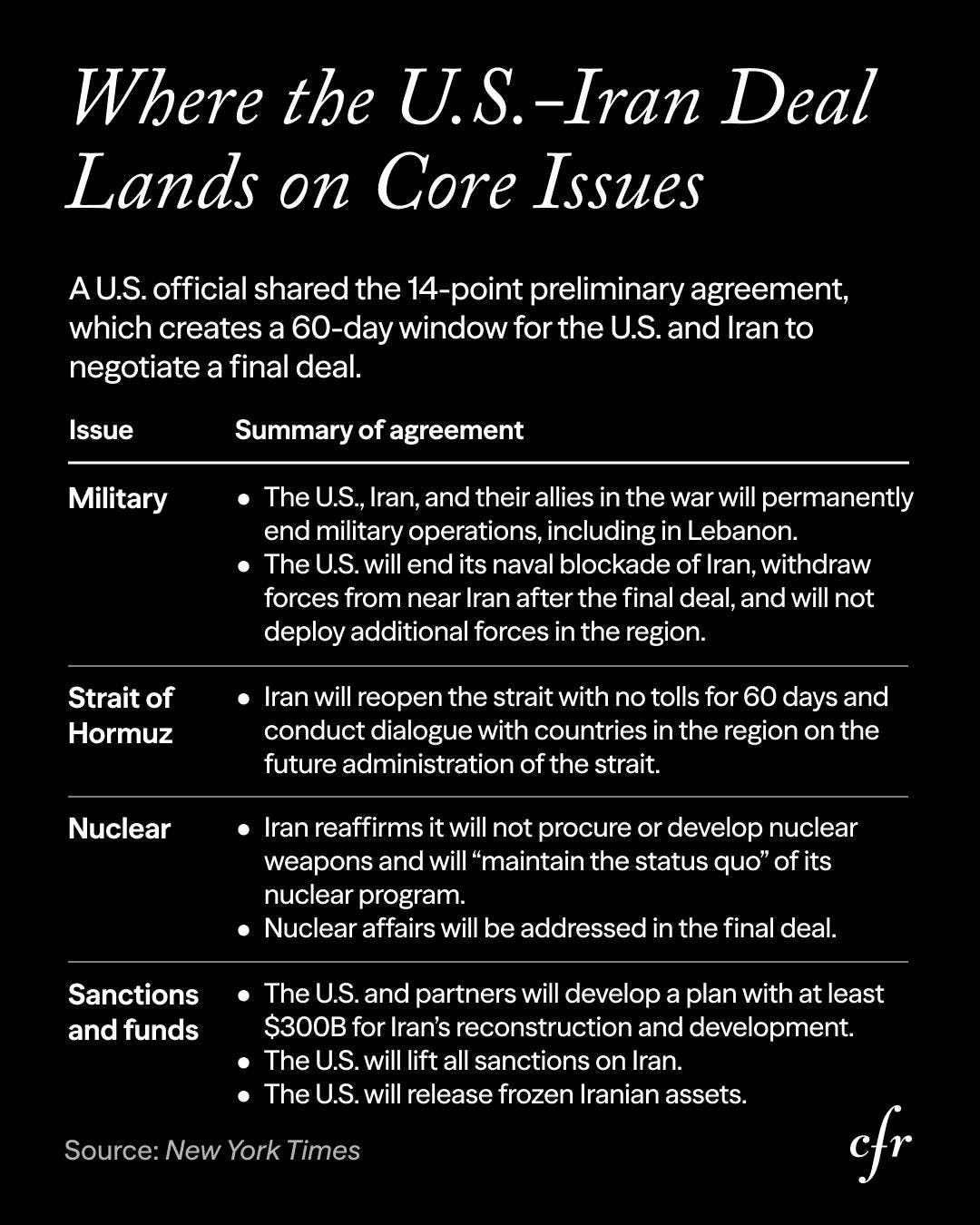
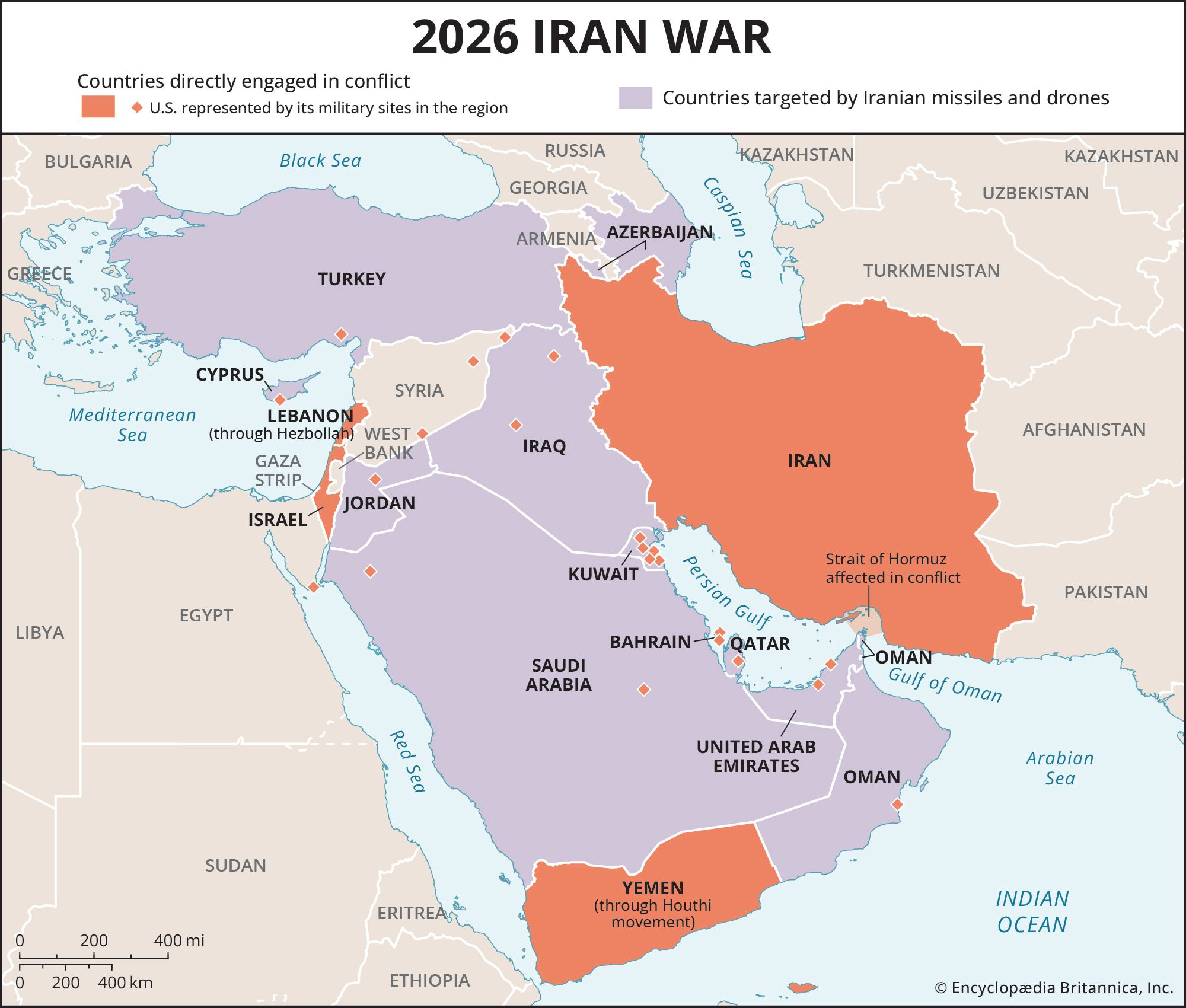
The White House sent Congress the text of the interim agreement, titled the “Islamabad Memorandum of Understanding,” after Trump signed it with Tehran. The document calls for an immediate end to military operations on all fronts, including Lebanon; the U.S. ending its naval blockade on Iranian ports within 30 days; Iran ensuring safe passage for commercial vessels through the Strait of Hormuz for 60 days; and both sides negotiating a final deal within that window, with possible extension. Pakistan signed as witness and mediator.

The war began with Trump saying the goal was to destroy Iran’s nuclear program, end Tehran’s ability to strike neighbors, curb its support for regional allies, and open the door to regime change. Trump signed the deal with none of those objectives fully met. Iran restated that it will not acquire nuclear weapons, but it rejected removing enriched material from the country. Instead, the agreement points toward onsite down-blending under IAEA supervision.
Iran gets immediate strategic breathing room. The draft terms described by an Iranian official include U.S. commitments not to impose new sanctions before a final deal, oil-sanctions waivers allowing Tehran (and Moscow) to sell oil and receive revenue, the release of $25 billion in frozen assets, and a reconstruction/development plan to be negotiated within the 60-day window.
On the nuclear side, Iran agrees not to produce or acquire nuclear weapons and to hold its program at its current status while negotiations continue. But the details that matter most — enrichment, stockpile handling, inspections, long-range missiles, sanctions sequencing — are all pushed into the next round.
Washington gets the Strait of Hormuz reopened, oil moving again, and a way to stop the economic bleeding without admitting the war failed. The IEA said the closure showed the world the strait could be shut again, with more than 14 million barrels per day of Middle East oil output blocked during the conflict. Its chief Fatih Birol used the perfect phrase:
“The vase is broken.”
But there’s a tripwire. Called Lebanon.
Iran says Israel’s continued occupation of southern Lebanon would violate the deal, while a U.S. official says the agreement does not require Israeli withdrawal, and Netanyahu has said Israel will remain in Lebanon “as long as necessary.”
The markets got oil. Trump got a pause. Iran got time. The region got a countdown.
Iran is not presenting the deal as surrender. It is presenting it as survival with leverage intact. That may be the most important political fact underneath the paperwork. The interim agreement will allow the Strait of Hormuz to stop functioning as a global hostage note. But Iran also gets something less visible and arguably more valuable: time.
For Trump, the deal offers economic relief and a way out of a war that risked becoming politically and financially ruinous. For Iran, it offers a chance to emerge from months of bombardment without admitting defeat. Its nuclear program is not dismantled. Its regional network has not disappeared. Its position in Lebanon remains central to the next phase. And its leadership can tell the public that it forced Washington to negotiate after failing to break the regime.
Israel is treating the U.S.-Iran deal less as a peace agreement than as a constraint.
Israeli officials are angry because they think the deal does not deliver Israel’s core demands. No clear dismantling of Iran’s nuclear infrastructure, no serious curb on Iran’s ballistic missiles, and no real blow to Iran’s proxy network. The deal undercuts Netanyahu’s Iran narrative and exposes the limits of his leverage with Trump.
The far-right coalition reaction is even harsher. Ben-Gvir and Smotrich have attacked the deal, and Ben-Gvir is insisting Israel should stay in Lebanon. Vance snapped back hard, basically telling Israeli critics that Trump is Israel’s main remaining ally and that they need to “wake up” to their situation. He also said,
“You can’t just kill your way out of solving every single national security problem.”
— U.S. Vice President J.D. Vance
Israeli opposition leader, Lapid, has been calling the emerging deal a disaster and using it to hit Netanyahu for failing to turn military action into political victory. His argument is that Israel fought, but Washington negotiated over Israel’s head, and now Israel has to preserve freedom of action regardless of the agreement.
The most likely near-term outcome is not a full collapse of the Iran deal, but a messy narrowing of it. Hormuz stays open because everyone needs the oil moving before true global catastrophe. The nuclear talks begin because both Washington and Tehran need the clock to keep running. But Lebanon is now our pressure valve. Israel is unlikely to treat the agreement as a true restraint on its military freedom of action, while Iran will use every Israeli move in Lebanon as proof that the deal cannot become final unless its regional interests are protected. So the war may pause at the level of U.S.-Iran confrontation, but it will keep testing the edges through Hezbollah, southern Lebanon, and the question of who gets to define “ceasefire.”
So who flinches first? Our prediction: the U.S. flinches first publicly, but Israel flinches first tactically — and calls it “security coordination.” They will likely scale or pause certain strikes under U.S. pressure while insisting it has not surrendered freedom of action. Washington will likely make the first diplomatic concession, accepting ambiguity around Lebanon and Iran’s nuclear sequencing in order to keep the 60-day process alive. Iran, meanwhile, has the least incentive to blink early. As long as Hormuz remains open, oil revenue resumes, and the final terms are still unwritten, Tehran can let the others argue over what the deal means.
🎯 Ukraine Brings the Drone War Back to Moscow. Ukraine’s latest drone strike on Moscow matters less because of the spectacle and more because of the message. For much of the war, Russia has tried to preserve a basic asymmetry: Ukrainian cities live under constant threat, while Moscow remains the imperial capital watching the war from a distance. Ukraine is now contesting that asymmetry.
The Russian Defense Ministry said on Thursday it downed 992 drones countrywide, making it one of the larger attacks of the war (for either side) and a significant increase in scale from prior Ukrainian onslaughts. It also said it downed four long-range cruise missiles that were part of the assault.
President Volodymyr Zelensky of Ukraine, in a voice memo shared with journalists on Thursday, warned:
“If Ukraine burns, then your Moscow will burn as well.”
— Ukrainian Volodymyr President Zelenskyy
President Zelenskyy cast the massive drone attack as a response to an attack this week on the Pechersk Lavra monastery complex in Kyiv, one of the holiest sites in Eastern Orthodox Christianity. Russia looked to reverse blame on the strike and damage to the historic Ukrainian monastery on an errant Ukrainian interceptor missile.
The reported strike on the Moscow Oil Refinery, coming only days after another attack on the same facility, points to a maturing Ukrainian strategy. Kyiv is not merely sending drones toward symbolic targets. It is using long-range systems to pressure the infrastructure that sustains Russia’s war economy: refineries, fuel depots, logistics nodes, air-defense networks, and the aviation system around the capital itself. The goal is not to defeat Russia with a single dramatic strike. It is to make the war harder to finance, harder to hide, and harder to compartmentalize.
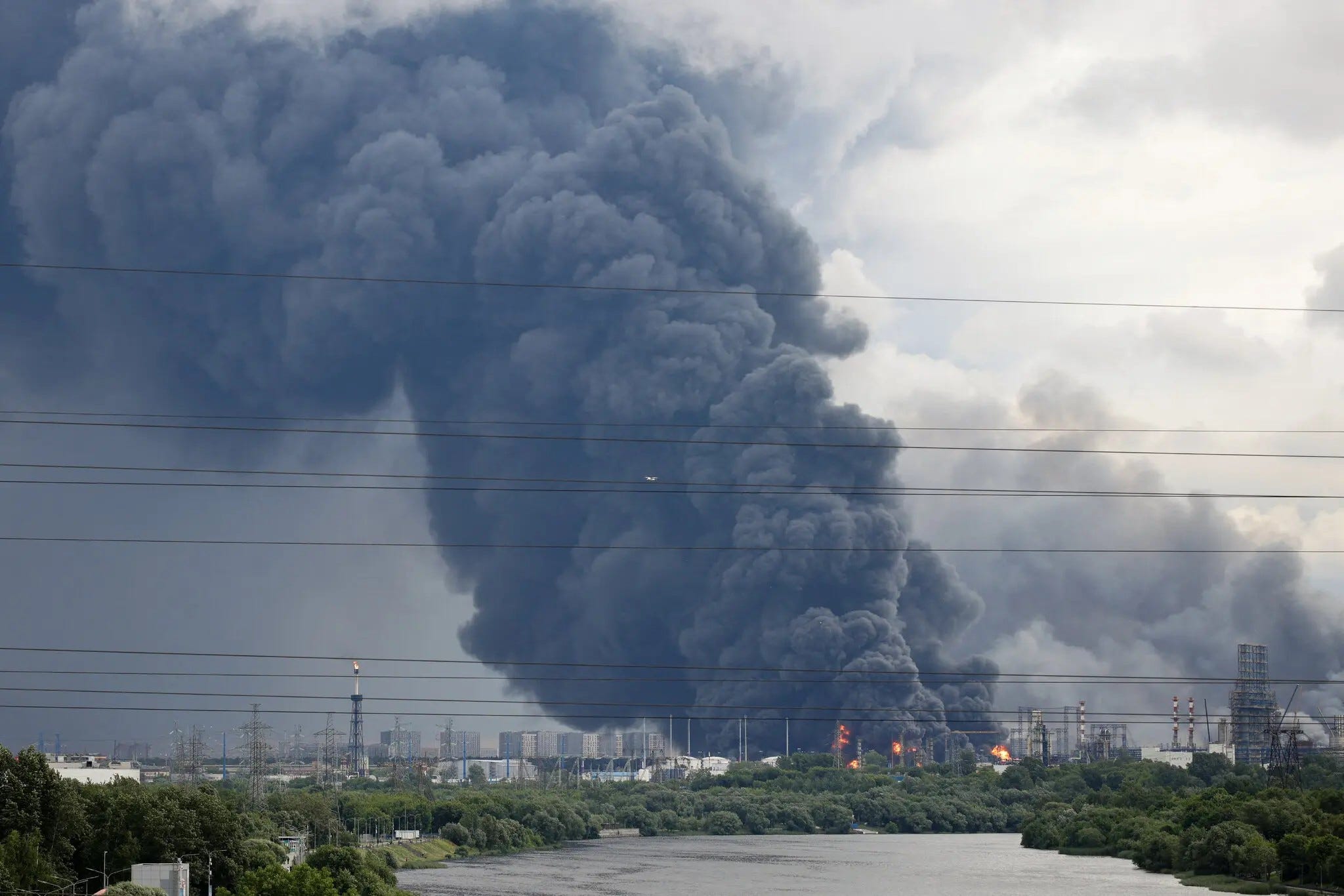
Oil refinery burning next to Moscow via Reuters
This is strategically important for three reasons.
First, it shows that Ukraine’s long-range strike campaign is becoming more persistent. One-off attacks can be dismissed as symbolic. Repeated attacks against the same critical infrastructure suggest a campaign logic.
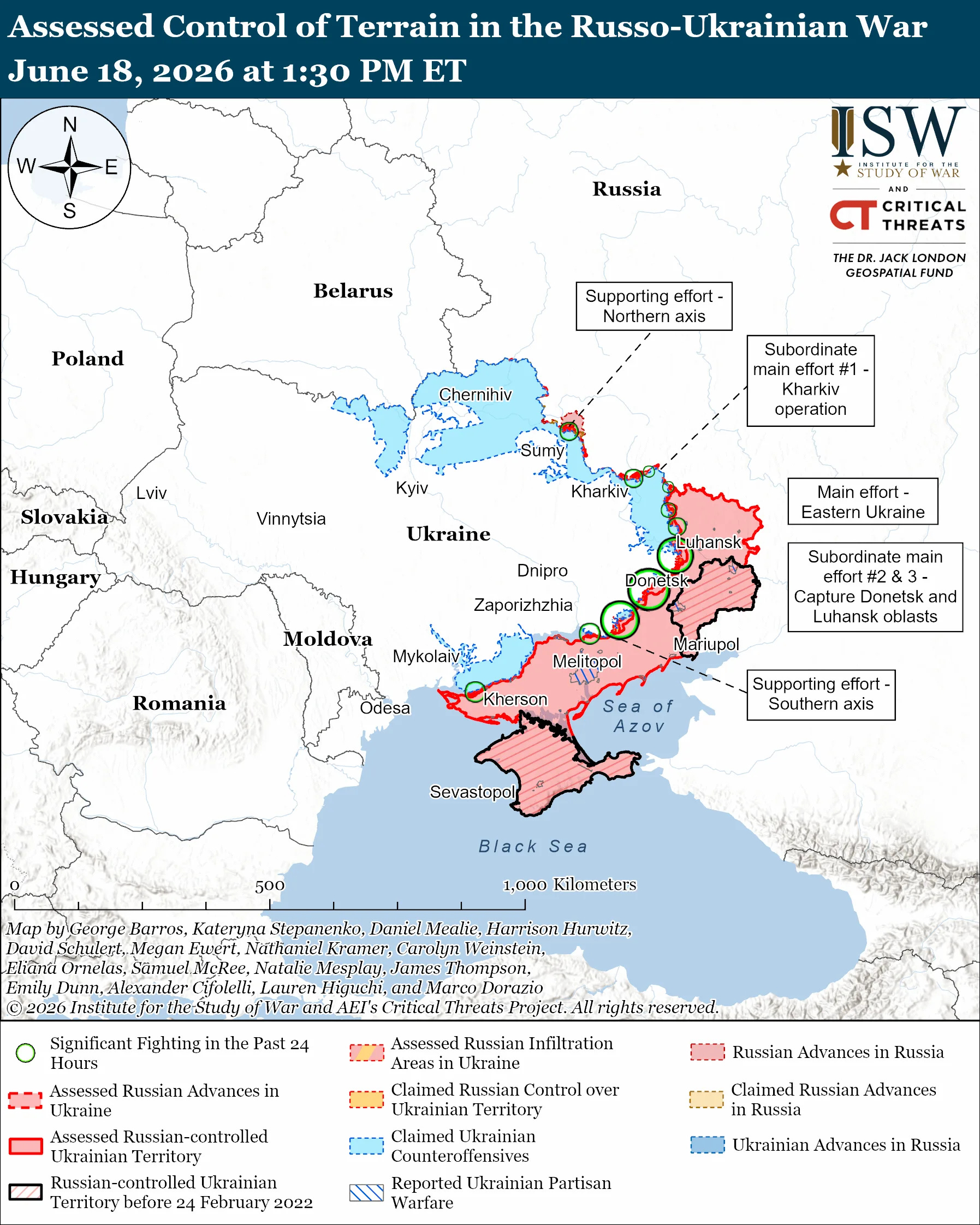
Second, it forces Russia to make uncomfortable defensive choices. Every drone that reaches Moscow exposes gaps in the air-defense system. Every additional system assigned to defend the capital is a system not defending occupied territory, military logistics, or the front.
Third, it attacks the political psychology of the war. Putin’s war depends in part on distance: the idea that Russia can devastate Ukraine while most Russians experience the conflict as background noise. Strikes near Moscow challenge that bargain. They do not need to produce decisive physical destruction to create strategic effects.
The danger, of course, is escalation. Moscow will portray the attacks as terrorism and use them to justify further strikes on Ukrainian cities. But that argument ignores the core reality: Russia normalized attacks on civilian infrastructure years ago. Ukraine is now demonstrating that Russia’s own strategic depth is no longer immune.
The broader pattern is clear. The drone war is no longer confined to the battlefield. It has become a contest over endurance, infrastructure, and political will. Moscow wanted a war in which Ukraine’s cities absorbed the pressure. Ukraine is now showing that pressure can travel in both directions.
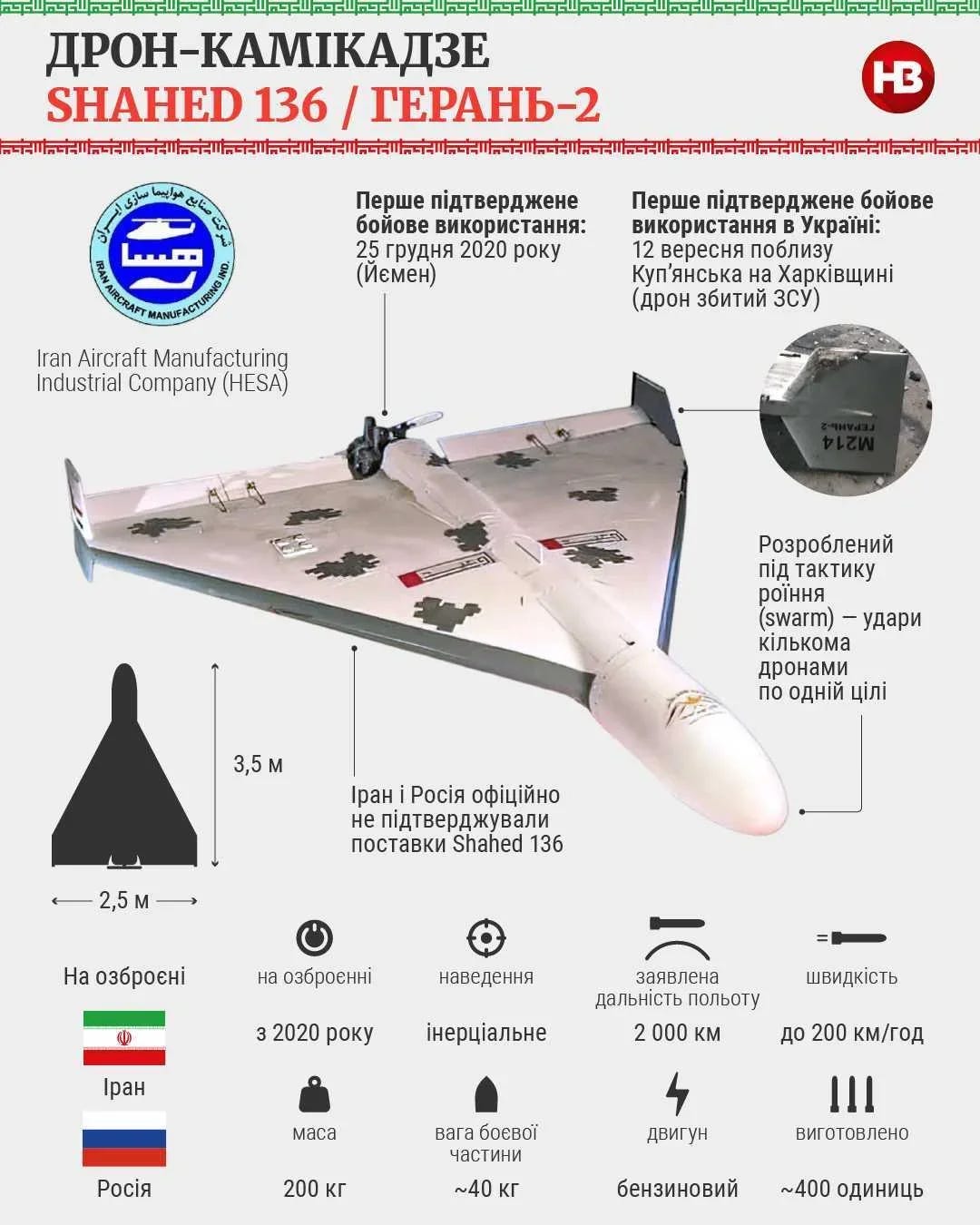
Shahed Kamikaze drones are Iranian-made and used by both Iran and Russia
🎯 Cuban lawmakers unanimously approved more than 175 economic reforms that could mark the biggest shift in the island’s socialist model since 1959. The Cuban state economy is cash-starved, bureaucratic, and under extreme pressure from sanctions, fuel shortages, blackouts, tourism disruption, and mass emigration.
The measures would allow private banks, private real estate development, larger private businesses, and the sale of state-owned properties to Cuban and foreign entities, including Cubans living abroad. Havana insists it is not abandoning socialism, but the state is clearly trying to convert pressure into liquidity.
This moves Cuba closer to a China/Vietnam-style model that includes one-party political control plus controlled markets, private capital, foreign investment, private banks, private real estate development, and more autonomy for state enterprises.
At the same time, the U.S. Supreme Court has broadened the path for claims over property confiscated after the Cuban Revolution. In Havana Docks Corp. v. Royal Caribbean Cruises, the Court held that cruise lines’ use of confiscated docks could support Helms-Burton liability, even though lower courts had limited the claim. Legal analysts say the ruling lowers one barrier for claimholders, though many obstacles remain.
Cuba is trying to save political socialism by sacrificing parts of economic socialism.
The result is a strange two-front property story. Cuba is trying to open a future market in state assets while U.S. courts are reopening the past one. The island wants capital. The claimants want restitution. And between them sits the unresolved question that has haunted U.S.-Cuba relations for more than six decades. Who owns the revolution’s aftermath?
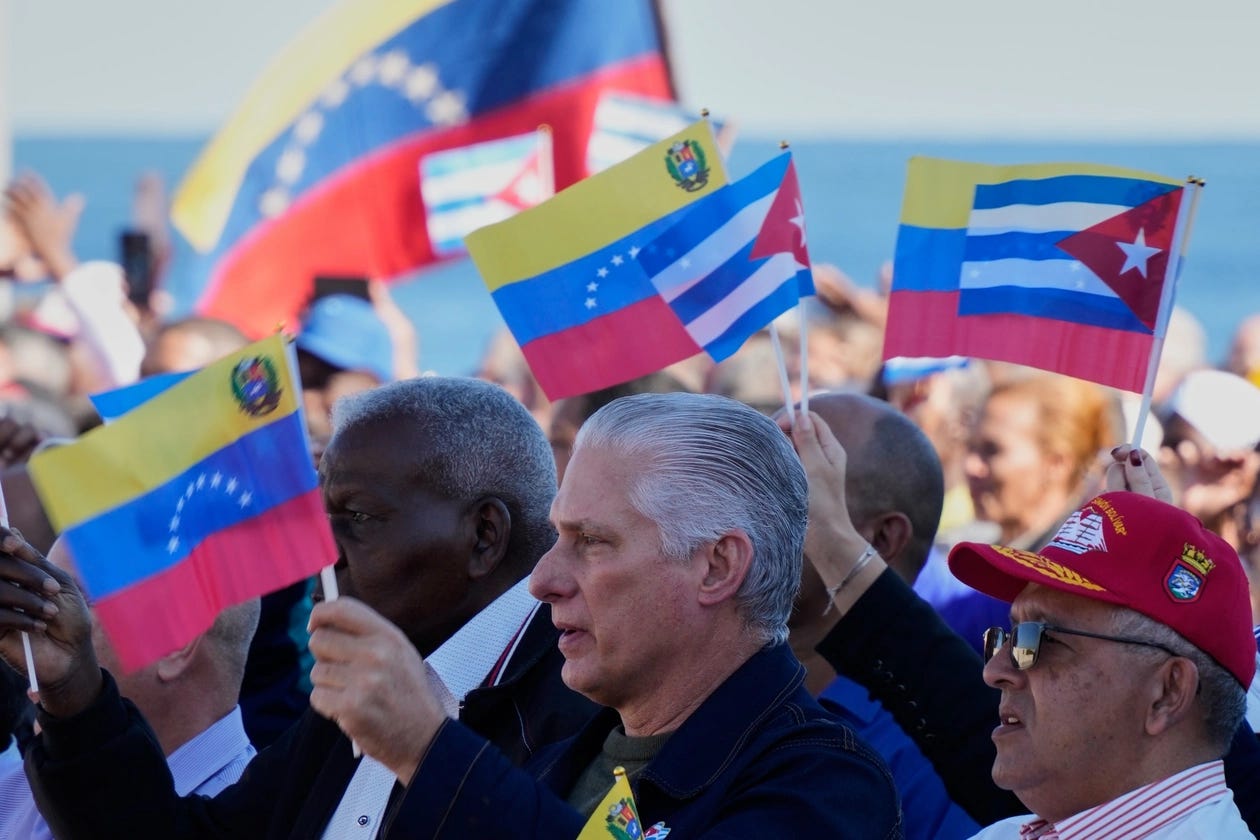
Cuban President Miguel Diaz-Canel attends a rally in Havana, Cuba in solidarity with Venezuela after the U.S. captured President Nicolas Maduro and flew him out of Venezuela. (via AP Photo/Ramon Espinosa)
Cubans abroad, including Cuban Americans in South Florida, may finally be able to invest in and legally own businesses on the island. The Miami Herald quoted Miami businessman Hugo Cancio calling it “historical change” and saying the diaspora has the capital and know-how Cuba needs.
But the hardline exile/political reaction is wary or hostile. Miami-area Cuban American officials and activists are concerned that economic opening without political change simply rescues the regime. Rep. Carlos Gimenez said there would be “ZERO investment from the US unless there is MAJOR political change on the island.” The Herald also notes that Miami exile organizations are unlikely to accept economic reform as a substitute for democratic transition.
Cuban exiles and Cuban Americans with confiscated-property claims see 2026 as a potential turning point, but they also fear Trump could prioritize business deals over restitution. The LA Times reported that hundreds of thousands of Cuban Americans are pursuing compensation for homes, businesses, and land seized after 1959, complicating any U.S.-Cuba negotiations.
Cuba wants capital because the state has run out of room. It needs hard currency, fuel, investment, functioning infrastructure, and the diaspora money it spent decades treating as politically suspect. But this is obviously not a clean embrace of capitalism or a clean surrender of socialism. It is something more Cuban and more precarious. An attempt to preserve one-party rule by letting markets do some of the work the state can no longer do.
🎯 China pushed back after G7 leaders agreed to coordinate efforts to reduce dependence on any one supplier for rare earths and permanent magnets. The G7 wants dependence on a single outside supplier cut below 60% by 2030, with a longer-term goal of 50%. Beijing called the move “small clique” rule-making, but the message from the summit was clear. Supply chains are now security architecture.
The age of cheap globalization is over. The age of strategic inventory has begun.
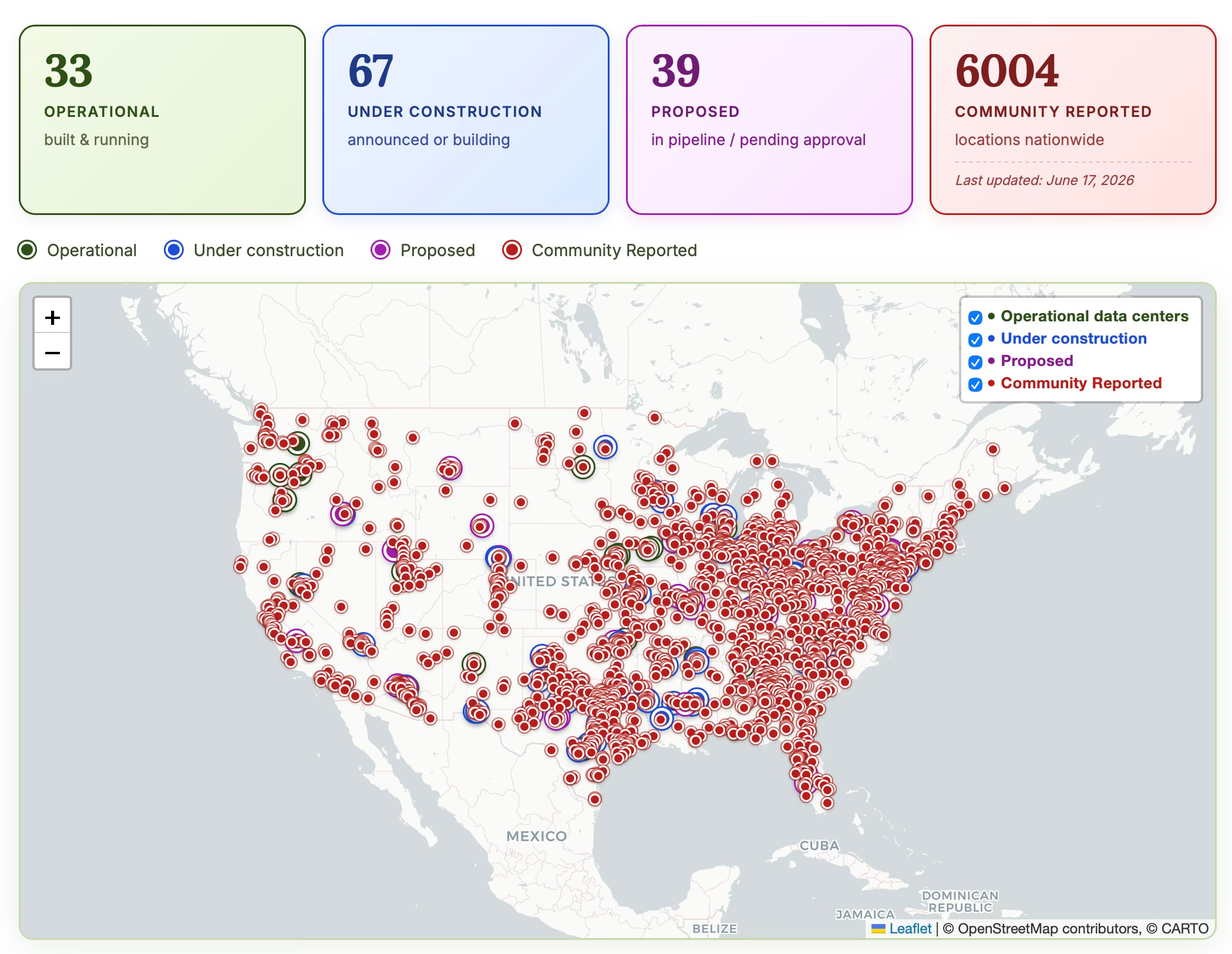
🎯 U.S. federal regulators just ordered grid operators to speed up power access for AI data centers. At least 57 off-grid U.S. power plants proposed or under construction to serve individual data centers, totaling 73,000 megawatts of capacity. AI-driven electricity demand could triple by 2035.
4,000+ data centers already operate in the U.S., with about 3,000 more planned or under construction. Federal regulators just ordered six regional grid operators to speed up access for large AI/data-center loads, with reports due in 30–60 days. Some of these facilities can consume more power than small cities.
Data centers currently use about 5% of U.S. electricity demand, and that demand could triple by 2035. That is why FERC is treating this like a grid emergency, not a normal commercial real estate buildout.
U.S. power demand hit a record 4,195 billion kWh in 2025 and is projected to rise to 4,271 billion kWh in 2026 and 4,397 billion kWh in 2027. EIA’s forecast ties the growth to AI data centers and electrification, with commercial power use expected to exceed residential use for the first time on record in 2026.
Texas is the alarm bell. ERCOT is tracking more than 438,000 MW in large-load requests, nearly 89% from data centers. Projects of 75 MW or more are being grouped into a new “Batch Zero” study to figure out transmission needs and grid capacity.
Globally, data centers used 448 TWh of electricity last year, more than Saudi Arabia, and AI accounted for about a fifth of that. By 2030, data-center power consumption is projected to reach 945 TWh, about the same as Japan’s entire electricity use, with AI accounting for 40%.
Water is the other buried number. Data centers used 4.5 trillion liters of water last year and are projected to use 9.3 trillion liters by 2030. CO2 emissions are projected to rise from 189 million tons to 399 million tons, while the land footprint could more than double from 6,900 square km to 14,500+ square km.
What Else Mattered This Week:
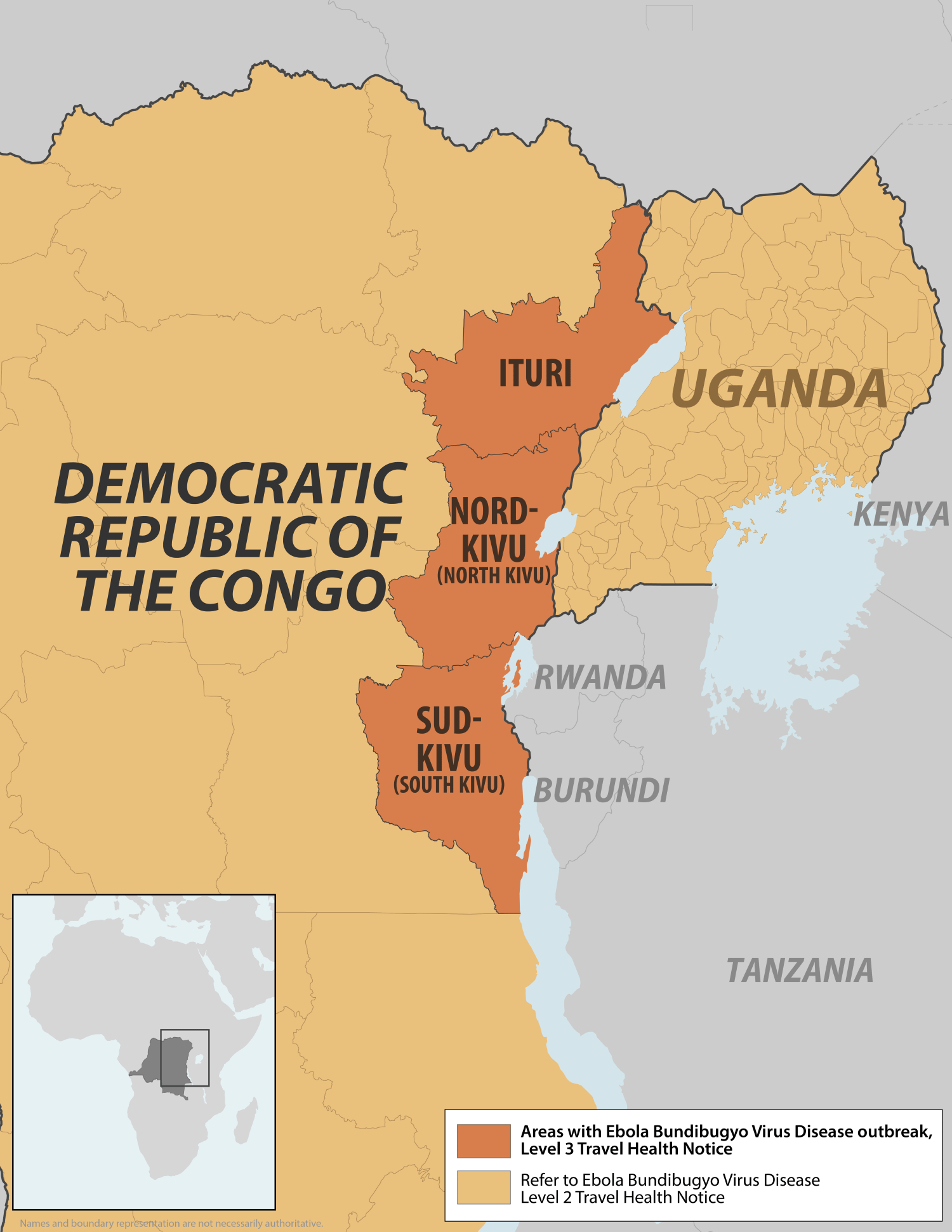
📍Kenya’s protests over a planned U.S.-backed Ebola quarantine facility at Laikipia Air Base have turned deadly, sharpening anger over who bears the risks of global health emergencies. The proposed 50-bed site in Nanyuki would isolate and monitor Americans exposed to Ebola amid an outbreak in the Democratic Republic of Congo and Uganda.
Local residents and officials say they were not properly consulted and fear Kenya is being asked to absorb a health risk the U.S. does not want on its own soil. Kenya’s High Court temporarily suspended the facility and the arrival of foreign patients after a legal challenge, while protesters demanded disclosure of the agreement with Washington.
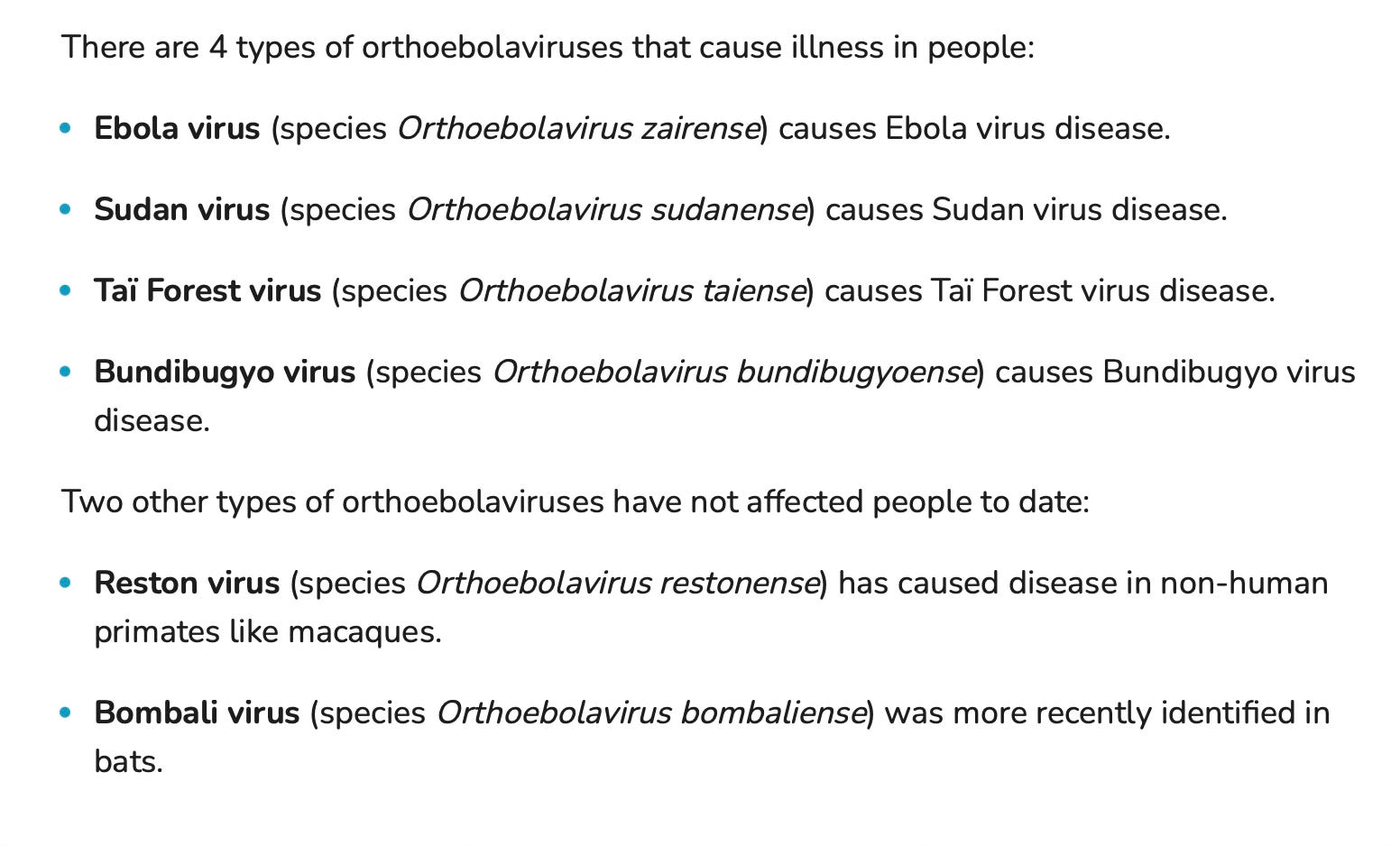
The fight is not simply about Ebola. Kenya currently has no Ebola cases, while the strain involved, Bundibugyo, has no approved vaccine or treatment, making public trust especially important. U.S. officials have paired the plan with aid for Kenya’s Ebola preparedness, but the politics are combustible. A quarantine center meant to manage American exposure has become a symbol of unequal biosecurity, military secrecy, and the suspicion that poorer countries are being asked to host the world’s danger zones.
The orphanage in Bunia is the emotional core of the outbreak. A newborn brought to safety after her mother’s death instead became one of Ebola’s youngest victims. Other babies were isolated, nuns fell ill, and health workers began daily monitoring of children and staff. That is the context behind Kenya’s anger over the U.S.-backed quarantine facility. Ebola is not theoretical. It is already moving through the places where children, caregivers, and exhausted medical systems have the least room for error.
📍Swiss voters rejected a right-wing proposal to cap the country’s population at 10 million by 2050, avoiding a direct clash with the EU and relieving business groups worried about labor shortages. The initiative, backed by the Swiss People’s Party, would have triggered tougher immigration measures once the population hit 9.5 million and could eventually have forced Switzerland to terminate its free-movement agreement with the EU. Switzerland’s population is about 9.1 million, up roughly 1.7 million since free movement with the EU began in 2002, largely because employers rely on foreign workers in sectors like hospitals, care homes and skilled industry. The proposal failed, but the margin was not irrelevant. Around 45% support shows that even prosperous Switzerland is turning growth, housing, infrastructure and immigration into one political question.
📍Colombia’s presidential runoff is increasingly centered on crime, armed groups and the future of Petro-era peace efforts (“Total Paz”). Right-wing candidate Abelardo De La Espriella is running on a hardline law-and-order platform that includes mega-prisons, deregulation, tax cuts and revived oil exploration, while leftist Senator Iván Cepeda is campaigning on social reform, higher taxes on the wealthy, land redistribution and continued negotiations with armed groups. Armed group membership has surged to about 25,000, stretching the state’s control in rural areas and making security the defining issue of the vote.
The runoff is not just left versus right. It is force versus negotiation, oil versus redistribution, and a test of whether voters see Petro’s peace agenda as unfinished work or failed strategy.
Colombia is voting on security, but the deeper question is what kind of state can still reach the places armed groups already have.
📍Britain is moving to ban under-16s from high-risk social media apps, joining a broader push from Australia to Europe to regulate children’s access to platforms. Australia became the first country to ban under-16s from platforms including TikTok, YouTube, Instagram and Facebook, with penalties of up to A$49.5 million for noncompliance, while the UK is aiming for a similar ban by spring 2027. The policy fight is no longer just about screen time. Governments are increasingly treating algorithmic exposure as a public-health and child-safety issue and forcing platforms to prove who is old enough to be there.
The age-gate is becoming the new seatbelt.

📍London Climate Action Week opens as governments and investors try to keep climate finance moving through a much harsher geopolitical moment. More than 75,000 participants are expected to gather around financing the green transition, resilience and energy security, with the summit landing between the G7’s critical minerals push and COP31 in Turkey. The timing is awkward in the useful way: AI is driving new electricity demand, wars are reshaping fuel markets, and governments are reprioritizing defense, subsidies and industrial policy. Climate finance is no longer just about emissions targets. It is about whether capital can build the grids, batteries, clean-tech supply chains and resilience systems that this new economy keeps demanding.
Art of the Week
Your breath of fresh art and culture.
“Do the best you can until you know better.
Then when you know better, do better.” — Maya Angelou
Ladies of the Minoan Court, an illustration by John Duncan, A.R.S.A. It appeared in Donald A. Mackenzie’s 1917 book Myths of Crete and Pre-Hellenic Europe.

Whoever you are, now I place my hand upon you, that you be my poem,
I whisper with my lips close to your ear,
I have loved many women and men, but I love none better than you.
O I have been dilatory and dumb,
I should have made my way straight to you long ago,
I should have blabb’d nothing but you, I should have chanted nothing but you.
I will leave all and come and make the hymns of you,
None has understood you, but I understand you,
None has done justice to you, you have not done justice to yourself
None but has found you imperfect, I only find no imperfection in you […] — Walt Whitman

What to Watch Next Week:
📌What to Watch Next Week
Next week will be less about a single decisive event than about whether several pressure points begin to converge.
The first is Ukraine’s long-range strike campaign. The drone attacks on Moscow showed that Kyiv is no longer content to absorb Russian attacks while preserving Moscow’s sense of distance from the war. Watch whether Ukraine continues targeting Russian energy infrastructure, and whether Russia responds by shifting more air-defense assets toward the capital. That would not end the war, but it would impose a real strategic cost: every system guarding Moscow is a system not guarding occupied territory, logistics hubs, or military infrastructure closer to the front.
The second is whether Western support moves from statements to implementation. The G7 and EU both signaled continued backing for Ukraine, but the important question is what follows: sanctions enforcement, air-defense production, frozen-asset mechanisms, military financing, and the speed at which pledges become battlefield capability. Ukraine does not need another symbolic calendar of solidarity. It needs industrial depth.
The third is Russia’s response. Moscow will almost certainly frame strikes on its territory as escalation, but the more important signal may be operational rather than rhetorical. Does Russia intensify attacks on Ukrainian cities? Does it accelerate its eastern offensive? Does it try to demonstrate that Ukraine’s drone campaign cannot alter the broader battlefield picture? The contest is increasingly one of endurance: Russia tries to prove that Ukrainian resistance is futile; Ukraine tries to prove that Russia’s war is no longer safely compartmentalized.
The fourth is the Middle East and energy markets. Conflict involving Iran, Gaza, Lebanon, or the Gulf can quickly interact with the Ukraine war through oil prices, sanctions politics, and U.S. bandwidth. A spike in energy anxiety would help Moscow indirectly by raising costs for Ukraine’s supporters and complicating Western political unity.
Finally, watch the diplomatic positioning ahead of the NATO summit in Ankara in early July. The summit is still a few weeks away, but the pre-summit bargaining is already underway. The central question is whether allies can turn the language of resilience into concrete commitments: air defense, defense-industrial production, Arctic and Black Sea security, and credible long-term support for Ukraine.
The pattern to watch is not one crisis in isolation. It is whether Ukraine, Russia, Europe, the United States, and the Middle East are now entering a more connected phase of the war — one where drones, oil, sanctions, alliance politics, and domestic pressure all begin to move together.
Spotlight on the Markets:
📌 A week to prove if it’s all talk and no action. Markets spent the week trading the U.S.-Iran deal as a relief story, but Friday brought the wobble. U.S.-Iran talks planned in Switzerland were postponed, oil erased some early losses, and global stocks turned lower as investors questioned how durable the truce really is. Brent rose to about $80.36 and WTI to about $77.88, though both were still on track for roughly an 8% weekly loss after Hormuz reopened and supply started moving again.
The S&P 500 ETF, SPY, was around $746.74, while tech-heavy QQQ was around $740.62, with QQQ outperforming as AI optimism continues to support risk appetite. Bitcoin slipped to about $62,614, a reminder that the broader risk trade is still sensitive to dollar strength, Fed expectations and geopolitical headlines.
Next week, markets get the inflation test. U.S. PCE data due June 25 will matter because the Fed remains hawkish and energy prices are still doing diplomatic cartwheels. If oil keeps falling, the peace trade gets oxygen. If Lebanon or Iran talks crack, the inflation-risk trade comes back fast.
Send us a coffee or tea via our QR code ☕️

Have a tip, idea, or something you want us to dig into? Want to collaborate? Want to advertise with us? Hit reply, send us a message—we read everything. Need a tailored briefing, want a consult, contact us so we can craft a solution to fit your needs.